



I want to begin with a truly enormous thank you to everyone who joined me for the online event. To those who spoke up about their experiences or connections with me, shared online information with others, and to those who pleadged for support for Davion Cares Foundation UG.
Kay Reeve remains the Emotional Awareness Expert within the business, while the new name allows a greater ability to serve.
Whether you spoke, danced, shared your perspective, encouraged me from the sidelines or simply came along to discover what I have been building, your presence helped make the evening incredibly special. Your feedback has helped me refine the homepage even further since Saturday.
Hidden Path Leadership has grown from years of lived experience, learning, writing, training and conversations. Seeing so many people come together to support its next chapter meant more than I can even express.
Here is the replay below - the speaker list is near the bottom of the page.
As with most of the networking communities I belong to, I am not asking you to sell to your network. I am asking you 'to notice the'hear' their conversations where something I offer might genuinely help and - when it feels appropriate, simply ask:
“Have you heard about Hidden Path Leadership?”
With four different pathways there's something for everyone seeking:
You may already know someone who would benefit.
Perhaps a colleague, family member or networking connection is:
You don’t need to diagnose their difficulty or decide what they need. Simply opening a conversation and sharing the website may help them gently discover the pathway that feels right for them.
For leaders, managers, ambitious professionals and business owners who enjoy active learning, our new Leadership Think-Tank Learning Event offers a different kind of development experience.
It brings people together to explore practical challenges, question assumptions and examine how financial decisions, emotions, communication and human behaviour influence business growth.
If someone springs to mind, please share this link with them:
https://www.eventbrite.co.uk/e/leadership-think-tank-learning-event-tickets-1999733867830
A massive thank you to some wonderful people who all came not only to listen and support, but to speak up about their connections and journeys with me as the Emotional Awareness Expert. The speakers were...
Rory LemonAid - NeuroCreative Leadership Coaching: https://www.linkedin.com/in/rorylemonaid/
Vanessa-Mary - Business Growth Community: https://seedscommunity.co.uk/seeds-growth-gatherings-online/
Sue Bayley - Autism Family Dynamics: https://autismfamilydynamics.uk/
Sean Hewitt - The Trusted Business Community Association: https://trustedbusinesscommunity.com/
Andrew James Crawford - Bsuiness Development Consultant: https://andrewjamescrawford.com/
And our wonderful Ben Mukasa - Davion Cares Children's Foundation UG: https://davioncaresfoundation.org/
If somebody mentions self-help books during a conversation, please point them towards the Self-Help Bookshelf, which they can find through the main website.


It is more than a collection of books. It is a growing community connecting readers, authors, mentors and people who value learning through lived experience.
Thank you again for being part of the launch—and for helping the right people discover the support, resources and conversations that may have been hidden in plain sight.
You don’t need to carry anybody along their path. Sometimes, simply illuminating the start of the pathway is enough.
With heartfelt thanks,
Kay Reeve
Emotional Awareness Expert
Founder of Hidden Path Leadership
Awareness creates understanding. Understanding creates trust. Trust creates growth.
Join us for an insightful conversation with Kay Reeve. She is an Emotional Awareness Expert. Kay clearly shows how emotions affect sleep quality and much more. She explains that emotions are not just conscious feelings. Instead, emotions work at a subconscious level. They are even active during sleep, helping our body function. In fact, emotions impact everything from our breathing to our dreams. This deeply influences our overall emotional health.
Discover how understanding the human emotional cycle can help you. You will learn about its four core emotions. This knowledge empowers you with practical emotional regulation techniques. Therefore, you can navigate life's challenges more easily. You will find relaxation, manage stress, and relieve anxiety. Furthermore, you can cultivate happiness on your own terms.
Kay shares her personal journey. For example, she helped her son cope with depression. From this experience, she created a powerful framework. This framework teaches how to recognize and redirect your emotional states. Ultimately, this offers crucial sleep tips for better rest.
This discussion will give you key insights. You will learn about managing emotions for better sleep. Discover how to drive your emotions, rather than letting them drive you. This leads to a calmer, happier, and more restorative life. Explore the power of mindfulness for emotional balance and sleep. Then, unlock strategies for truly restful sleep.
Watch the full video to transform your understanding of emotions. Consequently, you will find a clear path to superior sleep and holistic emotional well-being!
Thank you to Yewande Ralph of the Natural Fragrance Company, and Better Sleep Clinic, for inviting me to talk about Emotional Awarneess for healthy sleep.
In an exceptional event online on 13th November 2025, I launched my new book 30 Love Values as part of a combined event with my group the Self Help Bookshelf, and Davion Cares Foundation.
You can find details of 30 Love Values here, along with the launch interview from Oliver Marcelle, a relationship coach who praised the book highly.
This was not just a book launch for 30 Love Values, but a global online event on World Kindness Day, with Fundraising Effort for Davion Cares Foundation, caring for 62 children in Uganda.
Following the launch, we were joined by mystery guest Richard Crossman aka Santa Dundas, a Canadian actor, voiceover artist, and professional Santa, who joined us in full costume to support. Check out the video below, where Santa greeted the zoom audience, talking about the book launch, and talking to Ben Mukasa - Founder of Davion Cares, to support the fundraising efforts to help pay for one year's rent...
...so he has a roof to land on - and keep these children safe off the streets.
Other networking colleagues of mine from Silvatree and TTBCA - The Trusted Business Community Association (several who were present at the book launch event), are working on more fundraising events for food, clothing, education, healthcare, and more, on 4th December 2025.
Of all the gratitude's I've shared this year, receiving a copy of the receipt to say the rent has been paid for the year is top of the list. I geniuinely share my gratitude to 'everyone' who helped at the event, attended on the night, and to those who couldn't come, but donated all the same. You have all helped keep a roof over the heads of 62 homeless children for another year.
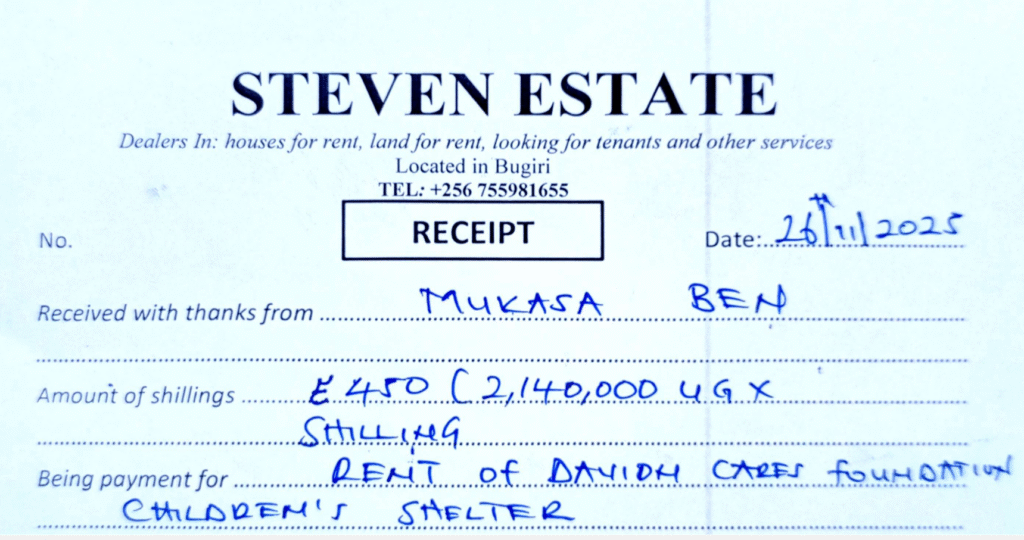
Another reason I am so passionate about helping Ben, is his holistic approach to supporting these beautiful children, including providing mental health support and education, empowering them with the best possibilities for a successful future.
Anyone ordering a personalised greeting up to 15th December can still continue supporting Davion Cares. Find details at Santa Dundas
To Rory Lemon, Sue Bayley, Rick McKenzie, Andrew Crawford, Ben Mukasa, Nicholas and Jesse of Davion Cares, and all the amazing guests: Once again, a massive thank you to everyone who helped raise and donate funds for Davion Cares Foundation at the book launch for 30 Love Values.

Young children often struggle to consider how their words affect others. Caught in their own thought processes, they may react defensively or speak bluntly, unintentionally hurting their friends or family members. This can be especially true for children as young as four, five, or six years old, who may not yet have the emotional tools to reflect on how their words impact those around them.
This post was inspired by Adam Clowes, and a post on LinkedIn regarding ADHD and people being emotionally dismissive. It led to a conversation about teaching younger children how not to speak hurtfully, and I recalled how I handled this with my children and grandchildren at times.
So, how can we help children develop the skill of mindful communication? In this blog post, we'll explore a practical and gentle approach to teaching young children how to reflect on their words while also protecting their own emotions.
The first and most important step in helping children understand the power of their words is to listen to them without judgment. When a child explains a difficult conversation they've had with another child, it's essential to pay close attention to their perspective. Try to understand why they felt the need to be blunt or defensive, even if they didn’t intend to be hurtful. By offering a non-judgmental space, you're allowing them to express their emotions and thoughts openly, which is a crucial first step in helping them develop empathy and self-awareness.
Once you’ve listened to your child, it's time to engage them in a reflective conversation. A gentle, curiosity-driven question can help them start thinking about the impact of their words. Ask them, "How would you feel if someone said the same thing to you?" This simple question invites the child to shift their perspective and consider how their words might have felt if they were on the receiving end.
By prompting this reflection, you're helping the child take a step back and understand the emotional weight of their words. The goal isn't to make them feel guilty but to cultivate an awareness of how communication can affect others.
After the child reflects on how they would feel if the situation were reversed, ask them how they would have preferred you to respond if you were in the other person’s shoes. This question encourages the child to think of alternative ways to handle a similar situation in the future.
Encouraging children to come up with their own solutions builds their problem-solving skills and fosters emotional intelligence. Instead of simply telling them what they did wrong, you're guiding them to find their own answers, which empowers them to handle future conflicts more effectively.
In the final step, use the child’s response to reflect on how they could approach a similar situation next time. Ask them to think about how they could communicate more kindly or constructively. This reflection helps solidify the lesson, making it easier for the child to apply it in future interactions.
By following this four-step questioning process, you help draw your child’s mind out of their immediate problem and encourage them to view the situation more objectively. This process teaches children to experience the situation from another person’s perspective and to think about emotions—not just their own, but those of others.
Ultimately, this approach helps children develop compassion, which isn’t about being weaker or giving in. In fact, it often requires strength to stay calm, think carefully, and respond responsibly. Even a child as young as five has the potential to grow in this way, learning valuable life skills through constructive conversations and open communication. With patience and practice, you can help your child understand the impact of their words and foster empathy from an early age.
It is rare for me to talk about strategies for younger children, because my business model, books, and courses, are aimed the teenage market. One the other hand, my emotional awareness strategy works across every age group. If you have young children and love the idea of raising them with Emotional Awareness and Empathy, check out Brain Unchained and get ahead by studying the strategies for yourself first.

My business value is Being Human, yet credit in part goes to AI for taking this concept in verbalized transcript - and re-writing it in a readable manner. This is the first time I have used AI to level-up my post, while the strategy mentioned, for helping children build Empathy skills, is entirely my own scattered thoughts and experiences.

Mindfulness is about letting your mind take a break from the stresses in your life, and doing something mentally relaxing. These free mindfulness colouring tips help you create a beautiful way to let this happen, especially when you add in a few extra tricks to relax all of your senses.
When you are working or busy, studying, or just on the go, your brain is in motivation mode, producing adrenaline for focus and dopamine for rewarded happiness. Being in stress mode produces cortisol. These are important but your brain also needs times when it relaxes, and allows serotonin to step forward. When your brain is allowed to relax, it switches from problems solving, or fear based stress, to creativity mode. Then when you lease expect it, you have your brightest ideas of all times. So it makes sense to proactively nurture your mind this way.
There are various forms of mindful colouring, from pictures to patterns, grids, geometric colouring sheets and more. Think about which you like the idea of today. It if is picture, do you want flowers, objects, foods, animals, or full page pattern prints? The options are limitless.
You can download and print individual mindfulness colouring sheets on this website, or you can purchase whole books online or in the high street.
You can use a simple set of colouring pencils or felt pens if starting out, to see how you like the process of colouring. If you wish to progress, there are many different types of pens available, from fine tip felts, to brush tips, water colour pencils, pastels, or you could try art pencils with black and white shading.
If you print yourself on stronger card as opposed to paper, why not try paints too. You can also print on different colour cards, to create different effects.
This is the creative part that you can experiment with until you find a way that suits you. Maybe start with a pattern, and block colour each shape. When you are better, try shading, or blending colours according to the overall pattern. Another option is to doodle patterns into larger shapes or backgrounds, rather than block colouring them. Look on YouTube for examples of what others do for inspiration.
Colouring can be done at home quietly, or at a table during a break time. Sitting in the garden, or park during summer. With a group of friends with coffee and cake included. Mindful Colouring supplies are often found in libraries too, so people can sit quietly for time out.
Depending on the length of time you have free, a few minutes here and there is ok, or taking an hour to colour on a day off, is all helpful in creating that balance over time. Some people like to include mindful colouring in their daily journaling, while others like it as a stand alone project. What you choose is entirely your choice.
Again, this depends on the time you have available. If you supplies are always ready on a desk, it is easy to squeeze in a few minutes between other tasks, or if you have to stash supplies away, then make colouring sessions a little longer and worthwhile. Anything from five minutes to five hours or more is acceptable. Daily, weekly, or even once a month. It is all about finding a time to let your mind have a little break from daily stress.
Colouring is all about using your visual senses, by selecting colours, looking at patterns, following lines and filling in shapes. Mindful colouring can also be about other senses when you add in these tips. Adapt these if you are going to be outside...
#1 Hearing: Put on some relaxing music, or the radio, and let go of all other voices in your head.
#2 Smell: Put on a candle, incense stick, or make a fresh coffee to entice your sense of smell.
#3 Taste: Chewing gum, or sipping a cool drink are two ways of bringing taste into your mindful actions.
#4 Touch: Feel the paper, the pens in your hand, the table surface your seat and more for mindful contact.
Now you are set to start your mindfulness colouring, and don't forget to keep your best images together, so another day you can simply enjoy looking back over them for more relaxation.
Remember to check out the latest in the shop.
If you want more tips for daily mindfulness, check out the course 10 Steps to Beginning Mindfulness
Let me know if these Free Mindfulness Colouring Tips helped you, or share your completed image on my Facebook Page.
Enjoy these two FREE mindfulness colouring pages to get you started.

How emotional awareness helps, can be seen by comparing the reactions of different people, in an identical setting. It helps to understand why some panic, some get angry, and others handle things calmly. Let's use a car crash, a bystander, a first aider, and a paramedic as example.
Imagine three people at the scene of a car crash. Let's compare their emotional awareness and how each would react...
The First panics, as they have no training, don't know what to do and their emotions take over. Their heart beats fast, they feel overwhelmed, shaky, and stumble or shout down the phone to the emergency services.
The second steps forward nervously to help as they have first-aid training. The have a kit, they have practiced regularly, yet they still feel nervous. They will still feel many of the emotions from above, but they are able to put that into action to some degree. They can provide life saving skills while the bystander calls for help.
The third is a paramedic who arrives last, steps in calmly, is trained, equipped, and takes necessary action. The paramedic has extensive training, and practices on the job every day. They also tend to work in partnership with a colleague.
Thinking about these three people and why some can stay calmer than the others, it is about the training that each received. The practice they put in, and the resulting change to their emotional ability to handle the situations.
The same applies to many things in life. The first time you get behind a steering wheel, or take your driving test, compared to a few years after holding your license. It all has bearing on how you 'feel' and how you handle your emotions when driving. Knowledge, and practice.
Life is very much the same across the board when it comes to dealing with emotions. Training helps alleviate the overwhelm, by teaching you what to do for a positive outcome. What changes you need to make, or thoughts you need to accept, to create peace and happiness again.
Emotional Awareness helps all ages - children, teen and adults - to deal with many different circumstances. Like the first aid training, they also learn to assess situation, remain calm, ask for help where needed, and choose the right emotional tools for the job.
Learning Emotional Awareness with Kay Reeve, can be thought of like learning first aid when starting with the ABC (Airway, Breathing, Circulation). In this case, the core emotions of Happy, Sad, Angry, and Depressed help you start learning about the emotional cycle. Once you recognise and understand the vital signs of these emotions, you can start learning how to respond to them differently.
As you learn more, you begin to recognise the feelings that accompany moods and how to create a change in your response. You also start seeing your learnings through other people, or by reflecting on past experiences. That's and amazing feeling when it happens.
This is where my book Brain Unchained teaches emotional awareness in a 3 step process...
Once any child, teen or young adult begins this journey of learning, you will be amazed at how quickly they begin to change. How eager they are to feel better in themselves. How they will want to learn more once they see the benefits. You may even see them helping friends and leading the way.
There is also a 'Safe Space for Parenting Teens' course available on this site.


Adults and young adults benefits from learning Emotional Awareness too. To help you start learning today, I have created a free introductory course so you can see how the emotional diagram works.
Emotional Awareness for Beginners and
Safe Space for Talking to Teens
Follow the first link to get access to all three courses online, and more.
Summary
Emotional Awareness will not stop you having emotions, but it will certainly cut back those extreme reactions, help you process emotions more effectively, and give you a tool kit for talking. Either about your own emotions, or if you are helping a friend, or your own teenager - the tools to help them begin emotional awareness too.
Emotional Intelligence develops in many stages, starting with growth beyond the subconscious mind. For example, babies begin by having emotions that make them cry or relax, before they even learn to smile. By the time they reach the terrible two's, they are learning that life is filled with desires and barriers. They don't yet have the emotional awareness to overcome all barriers, so it results in dramatic meltdowns. This is where learning begins.
To get from there to emotional intelligence, there are many layers of growth. Along the way, most people inherently absorb the ability and skills to navigate life. For many the learning process is not natural - such as with neurodiversity. Others live in situations that passes on negative learning such as through abuse or neglect.
Not all abuse or neglect is intentional. It's the age old story of a child permanently left with a babysitter. The child who is raised by a single parent with long term depression. The child who is constantly bullied in a larger family, while parents are busy being gown up. Parents themselves still living with the effects of trauma can inadvertently pass on emotional learning such as fear and avoidance. What matters most is learning to improve life going forwards.
During the terrible two's children quickly bounce back. They magnificently fail forward without doubting their ability to keep growing and learning. That is when learning is natural, progressive, and filled with hope. They are learning some forms of self-awareness. at this stage. What they want, what they like, and what happens when they can't get it.
By the time they reach teenage years, their emotional development has been through many stages of growth, yet these five steps are consistent throughout. As a parent or teacher, understanding this process, helps you support them.
With the right circumstances and mentality, teenagers can display high levels of emotional intelligence. displaying this levels across all aspects of life, is rare. Some are great with family, but a menace behind a steering wheel. Some adults are emotionally intelligent at work but not around family, and so on. That's why the rest of these steps are crucial to every aspect of life - including parenting.
Daniel Goleman describes five levels of emotional intelligence that are a natural progression of learning. These are all stages that can be learned from childhood, while for many adults, this is still a gap in their emotional learning. The stages are:
1. Self-Awareness
2. Managing Emotions
3. Empathy
4. Social Skills
5. Motivation
Over the next couple of years they learn more self-awareness. How they move, speak, interact, ask by saying please and thank you, and more. They learn who they trust and like, or what their favourite T.V. program is.
As teenagers, every situation comes with a new sense of self-awareness. What they bring to a situation, and what they can get from it. Who they are and who they like. How they behave, and how it impacts others. The list goes on.
Developing past the terrible two's, children will learn to lie, deny, rationalise and negotiate as part of their learning. This is about 'The Self' and what they want. It creates important progress in learning self awareness.
How these stages are responded to by parents and teachers, will affect how they develop emotionally. Reward them for lies and they will continue to do lie. Reprimand them too much and they may live in fear or hold back crucial information.
If a child or teenager is guided to do the right thing, they will learn and grow. by teaching them how to see the other person's point of view, and to understand how their own actions and reactions impact other people, they will learn empathy. This begins to transfers forward into empathy and understanding. they recognise that their self awareness must co-exist with that of others.
The skill of Empathy is more challenging for many. If they don't inherently learn this, then Social Skills become a little more challenging as a result. On the flip side, children with ample empathy, struggle socially to get long with children who have little to no empathy. This can often be ovserved as the anxious child vs the playground bullies.
By the time children are about 9 or 10 years old, they are more aware of their own body physically, their own internal feelings and emotions, and those of the people around them. They are even aware to some degree of the emotions in news, that affect the nations outside their own little world. This is all relevant to understanding empathy - not to be confused with sympathy.
Children and teens progressively become aware of a past, present and a future, and how that impacts feelings. They understand that memories can impact the present, creating excitement, anxiety, and fear. Some can ask rational questions to support friends, even offer sensible debate and suggestions on some levels according to their own knowledge and environment.
Some teenagers still struggle with self-awareness and cannot offer empathy. This is a potential sign of some unaddressed issues, that if not handled appropriately, can impact them for many years to come.
High school has the biggest growth impact on social skills, being the key focus from getting on the bus to greeting friends, or avoiding bullies and not getting called out by their least favourite teacher. Every school days becomes and emotional minefield, then home can add more pressure with homework, chores, and noisy siblings.
Teenagers frequently find their social skills challenged and overwhelming. It can hold back their education when they feel rejected, lonely or unworthy. In today's world this applies in person plus the online world of social media.
At every step of teenage life, they are learning new situations, new emotions, new challenges, and the support they receive, has an equally vast impact on how they learn to manage their own emotions. Not everyone knows how to navigate each new social situation. The next trend, being ousted, rejected, unrequited crush, failed exams, college refusals and more.
At every stage, communication is key. Whey they are support through the five step technique, life becomes a little easier and progress a little more hopeful. They need a little empathy too. When all this is in place, it transfers forward to them finding motivation within themselves rather then just doing what is expected.
Most teenagers can naturally motivate themselves and achieve their needs, once they have the previous steps in place. For some teens, motivation happens in early teens when they have been raised in an emotionally intelligent environment. For others they may reach their 20's and even 30's before obtaining even sufficient emotional skills to find motivation. These are the individuals who still struggle with social skills or empathy, affecting further education, employment, friendships, and relationships.
When motivation is not achieved, this is the time to start revisiting the previous stages and find out what is missing. What challenge is holding them back from motivation? Until they find this and resolve it, they will continue to struggle. Many will blunder through life unnoticed, but not truly happy. Many will be successful but always regret some choices along the way.
Teenagers who reached motivation level before going on to further education, are more likely to have higher grades, achieve higher pay levels, have wider friendship circles, or networks, and have a life they are happy with.
When children have all these steps in place, with great family support, and good social skills, they want to learn. They do well in school and excel at life naturally. This process repeats and repeats for every stage of life they go through. New situation, new awareness, new emotions and so on, finding motivation and success.
For others, the process of navigating these five steps is a lifelong CHALLENGE. The steps may come and go, with burst of enthusiasm followed by a world that falls apart at every hurdle. In a perfect world, every child should learn this before their teens. In reality, many adults are still discovering this, and suffer with stress, anxiety, depression, fear of failure, low self-esteem and more.
Teenagers who reach this stage early enough, are more likely to become leaders, managers, teachers, doctors, lawyers and more. Some may choose to go with more menial roles, but they do so with self-awareness that it was a choice, not a lack of choice. They are usually happy with their choice and more likely to stick with it as their chosen career.
There has been a negative history of people who have focused on emotion solutions incorrectly. From mental institutions to prisons and wars, there has been much mismanagement of emotional failure for centuries.
Today the world mostly accepts that emotions can be improved with gentle support, education, and rehabilitation. Many courses and therapies implement positive thinking, affirmations, meditation, mindfulness and more.
This all goes hand in hand with understanding emotions but there is still something missing for many. The ability to truly understand their four core emotions - Their emotional cycle.
For those with different influences such as strict cultural biases, anxious or angry parents, gang related culture, bullying at school and much more - these can be difficult circumstances for learning emotional awareness. Instead they learn emotional survival and self preservation.
These people's learning is over-ridden by negative experiences, coping strategies, barriers, bad habits, addictions, and destroy their chances at passing on emotional awareness skills to the next generations. So how can we help them break the cycle?
Today more than ever, we have excellent educational systems to teach children a wide variety of topics, yet more teenage mental health issues than ever. Why? Because the system does not teach them Emotional Awareness as a curriculum topic.
Point to ponder: We can go weeks without food, days without water, and minutes without air, but we can barely go seconds without emotions. So why is this not taught in schools?
The answer is simple - emotions cannot be seen. There has never been a constructive strategy for learning Emotional Awareness - till now.
My own son was depressed and suicidal. |He was unable to understand the emotional overwhelm that drove his behaviour. As a young adult, I developed a way to teach him. I created diagrams and strategies as I mentored him. It was so successful, in 2017 I gave a TEDx Talk and in 2020 I published the book. This is the foundation for all learning related to emotional intelligence at every level - find out more below.

View the Brain Unchained Synopsis or Buy Now on Amazon
Brain Unchained is a toolkit for talking. Parenting teenagers, and raising teenagers with Emotional Awareness has become a whole lot more achievable.

Teenage Depression has been recognized over thousands of years as being different to the depression experienced at other times of life. So what is it?
While many just call it a phase, or think its an excuse to get out of doing their homework, science has come a long way with the addition of brain scans, blood tests, improved therapies, and education, to help teens through this difficult phase. All the same, it still happens and there's nothing as effective as 'understanding' when supporting a teenager through depression.
Depression associated with the teenage-brain is proven to be a change in the brain's activities. On a brain scan, instead of showing an array of colours in reaction to stimuli, the results show large blue areas of inactivity. Ironically it describes how they behave - feeling blue.
Not all teenagers have this reaction to their adolescent years, or for some it is short lived, while others it may last for longer. Regardless of teenage brain, what happens when any teens have additional circumstances that cause depression separately?
Teenagers should be naturally lively, curious, social, and want to learn about their surroundings. They should be driven to succeed when everything is perfectly in place. Sadly in today's society, that is difficult to achieve and teenage depression is on the rise. Learn to spot the signs, and more importantly, how you can help.
Look out for the complete opposite to above: Has your teenager lost interest in learning? Do they struggle with social skills or talk about the challenges of friendships? Listen for concerns over self-appearance, or not being good enough. Notice if they become less chatty, or reclusive. Don't ignore signs of them hiding in their room more than usual.
Some teens go out more and 'hang-out' with likeminded friends. Keep an ear open for antics, or silence on return. Watch out for them getting addicted or obsesses with personal hobbies in a self-destructive manner. Online gaming is an obvious escape from reality but for some it may be comics, sports, or something else. These are all 'signs of depression'.
Look out for dietary signs and what they choose or refuse to eat. Are they hooked on caffeine based drinks or junk food? Sometimes a few days of better food can make a big difference.
Another key one is not hearing them sing if it was something they did before. Look for obvious signs too like 'When did they last smile?'- I mean genuinely, laughing, and looking like they are truly enjoying the moment. Smiling for a camera can be masking, so look for the real reactions to surroundings.
Anger, stress and anxiety are also frequent accompaniments to depression, or pre-cursers that warn of issues arising. Having a regular outburst of pure anger at little things, is definitely a sign of depression.
Teenage depression is often caused by overwhelm at school, or family stress at home. It may be from bullying from friends, enemies, or siblings. It there a dysfunctional relationship with one or both parents? Like the old saying 'Mummy's Boy or Daddy's Girl' it can sometimes be a source of friction in the family.
Emotional overwhelm may be over a hormonal crush, when their interest is seeing someone else. Maybe their teachers don't believe they have what it takes to get their dream job. Maybe they feel self conscious that they can't decide what they want from a career. There are so many possibilities.
When a teenager shares their thoughts and someone tells them "Don't be silly." or "You'll figure it out." or one of many phrases that dismiss their thoughts without 'fully listening' it leaves them feeling alone in the world with no one to help or support them.
Depression for many, is being caught up in personal circumstances from which they cannot see an escape. They lack the life experience and intuition to make necessary changes. They may be suffering abuse, even low level emotional abuse or neglect, which can result in more depression and feelings of low self esteem.
For some it is learning challenges, medical conditions, hormonal overload, social skills, educational challenges, and more. To them it is all personal and causes additional stress in their life.
See my 3 part blog posts about Creating Safe Space for Talking to Teenagers.
All the above can lead to overwhelm independently. When challenges accumulate, depression deepens. If this continues long term, a reduction in executive function skills may accompany depression, appearing as lethargy. Many parents see this as laziness, and apply MORE pressure.
Cognitive Function failure means no motivation or self belief. I've been there even as an adult and it is debilitating. No motivation results in more tasks falling behind schedule, and more social life falling apart, which leads to more pressure, nagging, or rejection from those who don't understand.
What they need now is support. They need understanding and compassion. You shine a torch for them and they will eventually find their way. This is their journey, but they need someone to guild them. They need emotional support, not emotional pressure.
If this is you, it's time to stop parenting and start mentoring. It improves life for the whole family. I'm here to help you make that change.
The best way to help any teenager through depression is to offer support. Be a listen ear instead of a voice in their ear. Be there when they need rather than telling them to be there for you. Be understanding and forgiving, without enabling negative habits. In time they will learn to trust you, and improve naturally.
Most importantly of all: Never tell them WHAT to do, teach them HOW to do it. Instead of saying 'Pull your socks up!' ask them 'How can I help you?' or 'What do you need to learn?'. Most importantly, be patient and consistent with your support.
You read this! You are absolutely the kind of parent that can offer this support for teenage depression.
Learn more about Emotional Awareness for Teenagers...
Parenting Teens Book: Brain Unchained
I have just started my memory journaling entries in my new book. I published My Journal The Gold Moments just one month ago, in May 2023. As I watched the coronation of King Charles III, I was talking to may father saying I recall Prince Charles as early as his 20's, being on TV and in the news. Now here he is being crowned the Oldest Monarch Crowned at his own coronation.
This goes in unison with me seeing Queen Elizabeth II go from a mother of teenagers - as Andrew and Edward were then - to being the longest reigning monarch, and seeing her funeral in 2022. She had become a grandmother, and great grandmother, going through all the same family drama many of us go through, while still being The Queen. If I had witnessed all this - what would my grandchildren witness? What will they talk about with their grandchildren in the future?
While I was discussing this, my father said how he remembered the funeral of Queen Mary (Mother of King George VI) and it made me think what my grandchildren will reflect on in future, at the coronation of Prince William - Prince of Wales which I hope to see, and later his son Prince George, which I am highly unlikely so see from this mortal plane. This got me thinking about memory journaling.
I was honoured the chance to see Prince George (on tv at least) as page boy, carrying the train for his grandfather King Charles III at his coronation. He looked every part a royal, and serviceman in his uniform, portraying a loyal and traditional future to come. One that my grandchildren are likely to be reflecting on with their children and grandchildren by then.
I now wonder what my grandparents remember as their earliest royal celebration. I wish I had something in a journal or notes to say so. I know my grandmother was a huge fan of the royals, and would paint portraits of the engagement photos from the latest magazine. While she painted, she chatted away about the lace wedding dresses, ornate carriages, and the Queen Mother - her favourite of all. If only my grandmother had left a memory journal with all her favourite royal memories in.
I now have many of my own memories about royal occasions. When my daughter was just one month old, my father (centre right) was working as a deaf-blind facilitator. The gentleman he worked for was a Services veteran.
Although Michael was still in his 30's, he had suffered devastating effects from two identical brain tumors at once. He was left deaf, blind, without a sense of taste or smell, and suffering epilepsy, yet he was a fighter. Michael had initially retained 10% vision, and started a desk-top publishing service. That was where my father began working for him.
Michael's work was aided by funds from The Princes Trust. That was how they were invited to meet with Prince Charles in 1992 - through the Princes Trust.
There is usually a protocol about standing too close to any royal, especially the next heir to the throne - as he was then. Prince Charles saw my father interpreting their conversation onto Michael's hand - like typing. He wanted to talk directly to Michael himself but didn't know the sign language. It all happened quite quickly and my father hadn't expected this. Michael was merely hoping he might get to shake hands with the Prince.
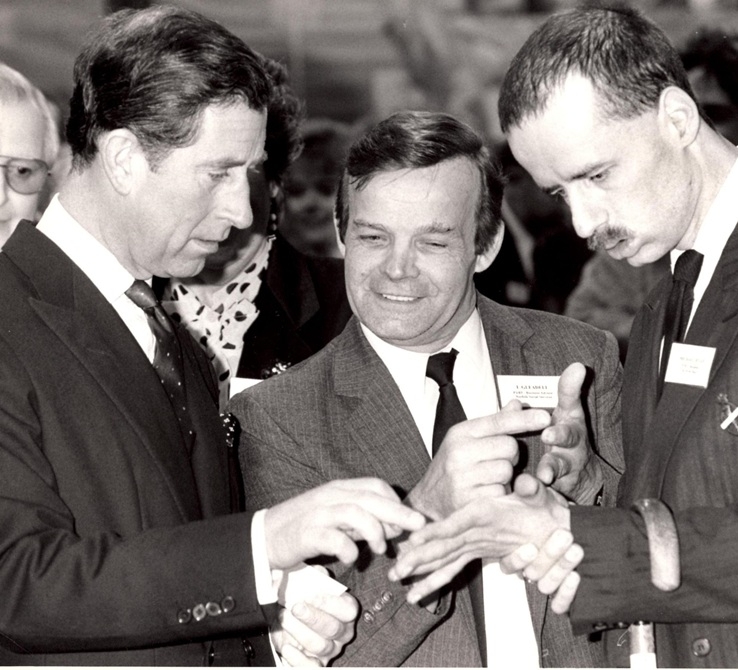
Photo of Prince Charles with my Dad & Michael in a rare moment.
My father let Michael know what was happening, then stood beside them as seen in the photo above. Prince Charles told my father what he wanted to say. Instead of my father tapping it onto Michael's hand, he tapped his own hand. Prince Charles then copied my father's actions onto Michael's hands, talking to him directly. It certainly made all of their meeting more special.
Prince Charles - now King Charles III as of today - has always has been a people's person. He stepped forward to do something out of the ordinary that day. It was simple, but it meant so much.
Their encounter created a memory to be handed down through my family. Even my grandchildren can see the photo on the wall at Grandpa's house but the photo needs words to help them understand it later in life, and keep the memory alive when we're no longer here to explain it. That's where memory journaling comes to mind.
Sadly that day my father met Prince Charles, also brought devastating news that Windsor Castle had caught fire. The humbling images next day of the Queen in her wellies, inspecting the ruins still come to my mind thirty years later as I write this blog post.
As I think about these moments, it is only a month after publishing 'My Journal - The Gold Moments'
I realise I could fill a volume, with memory journaling ideas like these alone, regarding important celebrations about royalty, meeting famous people, and headline news like the fire, Diana, and more.
My daughter at the age of 13, being home educated at that time asked me "How many kings and queens of England have there been?"
My face instantly recoiled through time and space. I was remembering the mono-tone hours of history lessons like life flashing before my eyes. I realised that the only thing I recalled was King Henry VIII had many wives and killed some of them. My honest reply was to point towards the computer as I said to her "Ask Google!"
To my surprise, she started searching, listing, chatting away as if she was listening to the latest TV soap. She went back to the computer every day, till a week later she came back with the answer Sixty Four. Some of the early kings had names I'd never heard of, such as Ethelred who reigned at the turn of century when the yearly dates jumped from 999 to 1000.
This was one of my favourite memories from home educating my children. I loved seeing my daughter learn more history in weeks under her own steam, than I ever learned in years at school. It was breathtaking and inspiring in many ways. It became a great conversation piece daily.
Then she said "I wonder how each got to take the throne from the others?" and so continued a beautiful project. Another one for the list of memory journaling.
I suggested she begins with what she does know - that Queen Elizabeth II took the throne when her father King George VI died. She then googled, chatted, and plotted on a sheet of paper till she run out of room. What now?
I suggested using another piece of paper to continue, like mapping a family tree. Several months later, after countless fascinating conversations, she had traced the lineage right back to the first King of All England and stopped there. It was too complex to continue, as it unmerged to kings of the seven counties - as England was then.
What a memory she created for us, the day she laid out all thirteen sheets of paper to show us her accomplishment!

Later come the memories of my grandchildren learning about the Queen for her 70th Jubilee. At five years old, my granddaughter told me of the story of a queen and the party at school. I told her the queen was real and she laughed. I showed her, her first video of Queen Elizabeth II and immediately her face lit up. She declared what a lovely lady she was and wished she could meet her.
Now I'm wondering how I can help keep this history going, of our own family memories. A collection of times and places that people like us were, what we were doing, and what we were thinking. A parallel time capsule to Royal History.
How can I create Something my grandchildren can talk about with their grandchildren many years ahead? It's time to start memory journaling with thoughts of their future conversations with their future generations.
Imagine if you and your family started their own tradition of journaling royal events, or any other celebration that is important to your family and culture. Memories that will remain for generations.
Here's my first 'Royal' Gold Moment entry in my copy of My Journal. I have so many other Gold Moments and memories to journal for myself and my grandchildren, about so many things.

My Journal - The Gold Moments - King Charles III Coronation and memory journaling

