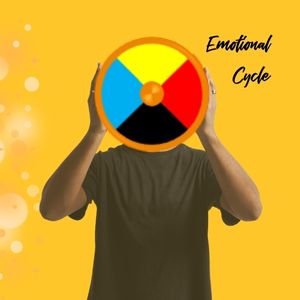
The emotional cycle governs every human being every day. It governs life it's self. Without emotions, there is no life.
Every day, every action, reaction and interaction you have, is based on an emotional decision. Even during sleep when your are dreaming you have emotions. So why is Emotional Awareness hard to learn?
Emotions often seem like something we have to put up with, and feel overwhelmed by. That's certainly how it feels in some schools and work cultures, although there are many that are taking a more proactive approach today, to ensure a more positive environment.
As a parent, I saw my son struggle with emotional dysregulation. He could not comprehend the world of emotions, as they were a messy invisible concept. By his teens he was a shell of who he could be. He was buried so deep under the depression that his true personality was barely there. How could I help him to SEE his emotions and start learning awareness in himself?
In 2016, that was the question that sparked either genius or insanity, because I haven't stopped thinking about it since. It didn't take me long to start creating a solution, in the form of colours and a diagram. That was just the beginning but it took a year to develop this diagram below. Not because the graphics are complex, but because the learning behind it had to be solid.
Children learn and inherit emotional mindsets from parents, family, friends and surrounding culture. Teenagers can find the shift into adulthood emotionally overwhelming. They face bigger challenges and setbacks than ever before. Yet they are expected to take control of their own emotions without the wisdom and experiences that life brings.
I have written a separate blog post about why teenagers struggle with teenage depression. As an adult we are expected to be in control of our emotions and yet for too many people, emotions are still very difficult to control. It seems only a minority truly master their emotions and lead the way for others.
Learning to process emotional overwhelm, can be overwhelming in it's self. Depending on the cause of the overwhelm, teenagers turn to friends, family, teachers, colleagues, managers, doctors and therapists for help. Why do so many still suffer stress, anxiety, burn out, tearfulness, grief, and overwhelm?
My son struggled severely with overwhelm, anger, and depression. We had been through that journey of searching for answers. We found a few along the way but still hadn't truly helped his depression twelve years down the line. Then I started developing the diagram above.
Emotional Awareness was the secret to my son overcoming depression. It helped me as a parent too. The first thing to realise is that being aware of emotions doesn't stop you having them. Being emotional is being human.
What emotional awareness does is help you identify your current state in the emotional cycle, using the colours on the diagram. It helps you find the changes that happened between emotions, and the root cause of the negative change. Only then can you work on resolving your emotions with the correct positive changes for your circumstances.
When parents learn this strategy and use it to mentor their own teenagers, the results are phenomenal.
It was through the need to help my own son, that I realised there is a universal pattern to emotions that happens regardless of age, race, religion, or your mental health status. I realised that even people with mental health issues, still have the same emotional cycle.
The diagram represents the four core emotions - Happy, Sad, Angry, and Depressed. The orange represents changes in emotions. When teaching my son this, we talked often about what had changed in his life and what he could do to make changes. for the better. That's where my book Brain Unchained was born.
I realised that even with my son's diagnosis of ASD I had found a way to teach him about the emotional cycle that worked. This improved his emotional wellbeing. He even recovered from depression, but his Asperger's is a lifelong challenge that will always be there.
That is why I use this diagram to differentiate between emotional health and mental health.
Regardless of mental health, emotional health can be improved. The two absolutely work in tandem, while each will exaggerate the other when one is out of sync. Mediations are crucial for many, to keep emotions in check but they don't teach someone how to manage their own emotions.
That is why I use the emotional cycle diagram, and recommend parents and teenagers learning emotional awareness together, with or without mental health challenges or neurodiversity.
Go to Brain Unchained on Amazon

